Protagonist's Preliminary Hearing
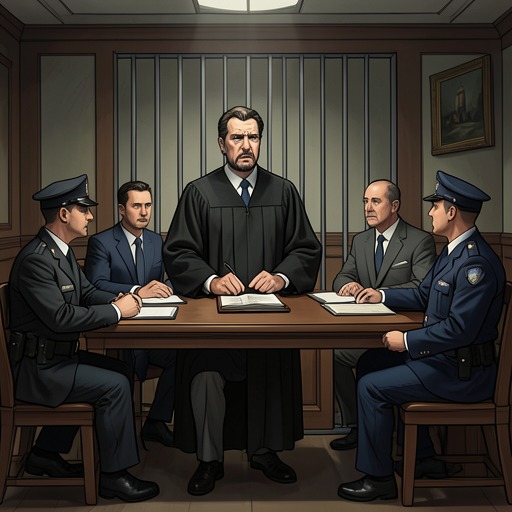
The RoomThe Unnamed protagonist’s preliminary hearing is both a legal proceeding and a crisis of agency: while the Courtroom moves through charges, testimony, stipulations, and motions, he struggles to understand what is happening and sees his own defender as another part of the machinery arrayed against him. The hearing ends without dismissal, but its deeper consequence is the conviction that procedure has shut him out rather than offered him a meaningful chance to answer the case.
Charges and Disorientation
The hearing begins with the Unnamed protagonist standing as the charges are read. He recognizes a few words, but most of the formal language sounds to him like an alien sequence of terms. He hears the sounds without taking in their meaning; he knows that he is standing in a real Courtroom, not dreaming, but says little else is clear. Asked for his plea, he answers not guilty.
A public defender is beside him, but the relationship begins without familiarity or trust. The Unnamed protagonist has only been vaguely aware of the man’s presence. The defender tells him to sit, places paper and a pencil in front of him, and instructs him to write down questions rather than speak while witnesses are testifying, explaining that he cannot listen to both the Unnamed protagonist and the prosecutor at once. The protagonist accepts the paper and pencil silently. He does not know the defender’s name and has never seen him before; as the man turns to his papers and speaks with the prosecutor, the protagonist concludes that he has already been sold out.
Testimony and Motions
The first witnesses are the arresting officers. The Unnamed protagonist initially tries to listen closely, pencil poised to record discrepancies that might help defeat the prosecution’s case. But as the testimony proceeds, he cannot find words for what is passing through his mind. His frustration grows, his posture sinks farther back in the chair, and the pencil eventually lies unused on the paper. His intention to monitor the evidence and supply his defender with useful points gives way to a sense that he cannot participate effectively in the hearing.
Much of the proceeding, as he experiences it, consists of procedural agreements and waivers. The attorneys stipulate to matters for the purposes of the preliminary hearing; the judge says that each is stipulated and enters it into the record. Items are waived and noted. When that sequence ends, the public defender asks the judge to dismiss the case on several grounds, citing cases and decisions. The prosecutor argues against dismissal and cites legal authorities in turn. A brief recess follows while the judge goes to chambers to consider the motions.
On returning, the judge speaks briefly with the attorneys, refers to their citations, and quotes some authorities of his own before denying the motion to dismiss. Questions and answers follow. The Unnamed protagonist sees his defender as allowing the proceedings to pass without doing anything for him, and experiences the hearing not as an argument in which he can be represented but as a succession of opportunities missed. The decision does not resolve his suspicion; it hardens it.
The Hearing as Experienced
The account makes a sharp distinction between the formal shape of the hearing and the protagonist’s grasp of it. The Courtroom has recognizable stages—charges, a plea, witnesses, stipulated matters, legal motions, a recess, and a ruling—but those stages do not add up to a coherent explanation for him. He listens, yet cannot reliably translate what he hears into notes or an understanding of the case. His initial plan to identify contradictions therefore collapses before the procedural activity is over.
His sense of betrayal is similarly personal and immediate. The defender’s unfamiliarity and attention to papers become, in the protagonist’s interpretation, evidence that the man has already abandoned him. The record does not establish that the defender failed to make legal arguments: he does request dismissal and cites authorities. The conflict lies in the gulf between that formal act and what the Unnamed protagonist believes he needed—an active advocate who would notice the discrepancies he expected to find and give him a role in the defense. His judgment of the hearing is shaped by this mismatch as much as by the judge’s ruling.
Return to the Cell and Aftermath
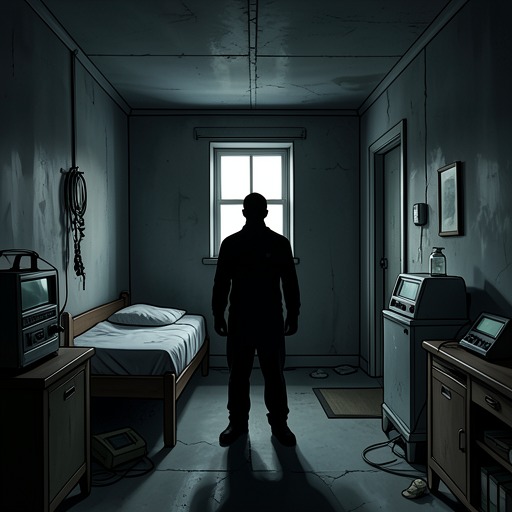
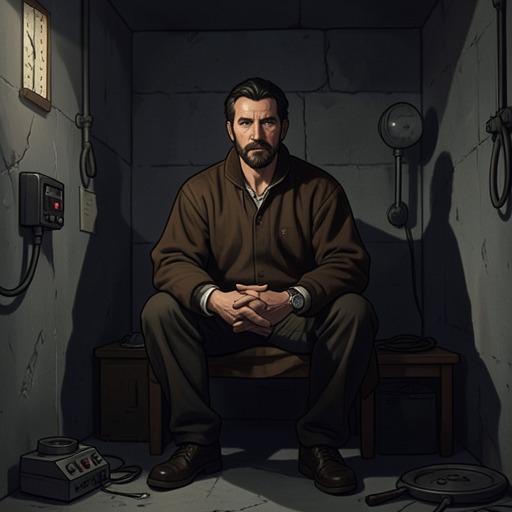
After the judge denies dismissal and the remaining questions end, the Unnamed protagonist is led out of the Courtroom and eventually back to his cell in The prison. He cannot say how long he sat in court, though other detainees later ask why he was there so long. Looking back, he reconstructs a day that began when a guard woke him at about 5:30 and ended with his return after 7:30, which he reckons as fourteen hours. The journey includes successive holding areas, changes of clothing, handcuffing to a chain, a bus ride to the courthouse, the Courtroom, and the return trip through more holding tanks. At the time, the waiting seems endless; in recollection, the entire day can be reviewed in minutes.
That compressed and distorted sense of time becomes part of the hearing’s meaning for him. He compares the proceedings to a ritual or a perpetual-motion machine: stipulations, waivers, questions, and answers keep the process moving, while he feels that no one knows or cares what the ritual is for. He imagines that he should have interrupted it, pushed his defender aside, and taken over. This is not something he does in court; it is a frustrated counterfactual that gives his helplessness a fantasy of control. He tells himself that this was only a preliminary hearing and that he will act differently when the case matters more, treating the next stage as an opportunity to defeat the rules he believes have constrained him.
The hearing also sits within the Unnamed protagonist’s broader account of law as a tool of police power. He argues that obscure and archaic laws make it possible to harass ordinary people, and that a vindictive officer can use authority to retaliate over minor conduct. Later, he generalizes his experience into a charge that the courts railroad defendants, contrasting severe consequences for petty theft with the lawyers and leniency he associates with wealthy offenders. These claims are his perspective, not findings established by the hearing itself. Their connection to the event is the way the denied motion and his perceived exclusion from his own defense become, for him, evidence of a larger system that he believes is designed to keep people like him from winning.